
Brands were going to replace influencers with AI avatars. Then 96% of advertisers said no thanks.
Two years ago, the virtual influencer was the future. Infinitely on-brand. Never sleeps. Never posts something regrettable at 2am.
Then reality showed up.
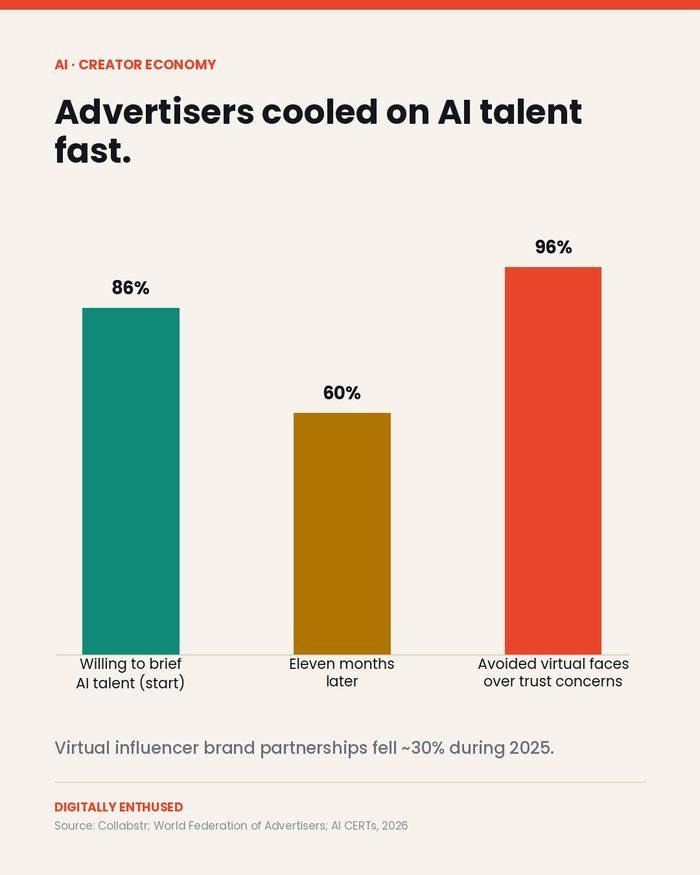
Virtual influencer brand partnerships fell roughly 30% during 2025. Advertiser willingness to brief AI talent dropped from 86% to around 60% in eleven months. A World Federation of Advertisers survey found 96% of advertisers avoided virtual faces over trust concerns. Lil Miquela — the poster child — lost 141,000 followers.
Meanwhile the market forecasts still say $45.9B by 2030.
Both things are happening. The category is being repriced, not deleted.
The case FOR synthetic talent:
40% of Gen Z follows at least one virtual persona and 33% have bought something because of one. The audience exists, whatever advertisers feel about it
Perfect control over messaging, availability, and localisation. One asset, forty markets, no reshoots
Cost structure is genuinely different once you're past the build
The case AGAINST:
Guess's AI-generated Vogue ad last August is still the case study people cite, and not kindly. The backlash was about who wasn't hired
Legal exposure on undisclosed synthetic media is a live risk with FTC rules still settling
You cannot borrow credibility from something that has never used your product, never had a bad day, and never risked anything by recommending you
Where I land: the value of an endorsement is proportional to what the endorser has to lose.
A creator with 30,000 followers who recommends your thing is staking her reputation. That's the entire mechanism. An avatar has no reputation to stake — which is exactly why it can be so relentlessly on-message, and exactly why it doesn't work.
Synthetic talent will find a real home in the places where nobody was ever trusting a person anyway: product demos, localised explainers, background presence. Not endorsement.
That's a smaller market than the forecasts want. It's also a real one.
Would you brief an AI avatar for a campaign this year — honestly? And if a brand you like used one without labelling it, would you care, or is that just me?
Notes on the data
Here's the tension I find genuinely interesting: partnerships fell ~30% and 96% of advertisers avoided virtual faces — while forecasts still project $45.9B by 2030.
Somebody's wrong. Either the forecasts are extrapolating a curve that already broke, or advertiser reluctance is a two-year blip.