
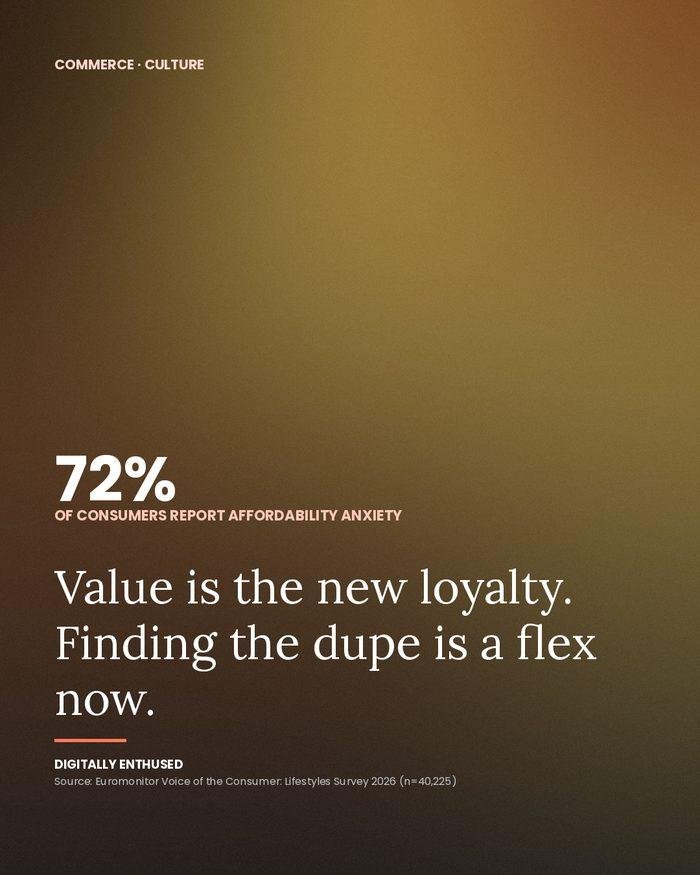
72% of consumers have affordability anxiety. Finding the dupe is now a flex, not an embarrassment.
72% of consumers report anxiety about rising daily expenses. 43% say they enjoy discovering bargains. 41% compare prices online at least once a week.
But the number that should reframe your brand strategy isn't a number. It's Euromonitor's framing: frugality has moved from a private necessity to a visible indication of intelligence and good judgement.
You've seen it as #dupe. Nobody is hiding the fact they found the $9 version. They're posting it. Getting credit for it. The shame has fully inverted.
That's a bigger problem for premium brands than a recession is, because a recession ends.
The case FOR competing on value:
It's where the market actually is. Pretending otherwise doesn't make anyone richer
Value framing is honest and it travels. People share a good deal in a way they'll never share a good margin
Loyalty programmes are getting genuinely competitive again, and there's real ground to take
The case AGAINST:
Discount is a one-way door. Very easy to teach a customer your product is worth 30% less; very hard to teach them otherwise
You can't out-cheap a marketplace seller with no brand costs. That race has a floor and you don't live near it
Value-seeking isn't the whole picture. The same research found over 55% prioritising experience-based spending and 22% planning to spend more on unique experiences
And "cheap" and "considered" aren't opposites. Euromonitor puts the resale sector at $41.6B — people trading up to things that hold value
Where we land: the answer to dupe culture isn't a lower price, it's a clearer reason.
Dupes win when the only difference is the logo. They lose when there's something specific and verifiable — it lasts four years, it's refillable, it's repairable, the resale value holds, the person who made it is on the packaging.
That's not premium positioning. That's being able to answer "why does this cost more" with something other than "because it's us."
Consumers aren't being disloyal. They're being rational, in public, for an audience. If your brand can't survive that scrutiny, the scrutiny wasn't the problem.
Marketers — have you actually pressure-tested your price story against a specific dupe this year? What did you learn?
Notes on the data
Voice of the Consumer, n=40,225, global, fielded January–February 2026.
Their exact wording is better than my paraphrase: frugality has evolved "from a private necessity to a visible indication of intelligence and good judgement." And they clock #dupe as "positioning frugality as a form of social proof."
That's the whole shift in one line. It isn't that people got poorer. It's that being smart with money became a thing worth posting.