
Live shopping is a $14.6B business in the US. We spent a decade insisting Americans wouldn't do it.
For about eight years the consensus was: live shopping works in China, Americans won't do it.
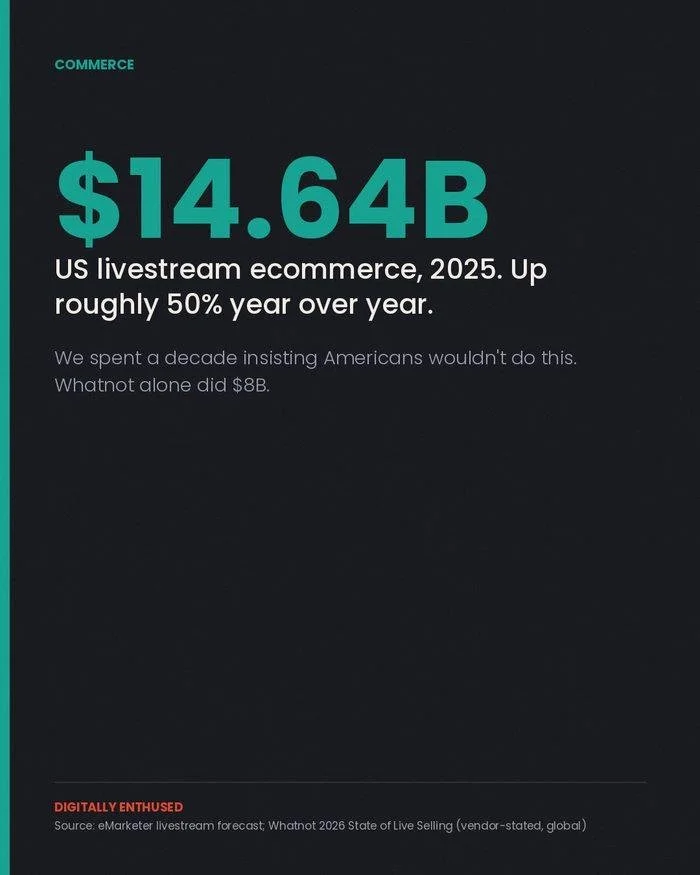
US livestream ecommerce did $14.64B last year, up nearly 50%. Whatnot did $8B in live sales globally and more than doubled year over year.
So what did we get wrong?
We assumed it was a format problem. It was a host problem. Nobody wanted a corporate presenter reading a script for 45 minutes. It turns out people will absolutely watch a two-hour stream — if it's someone they like, selling something scarce, with a comment section that talks back.
That's not QVC. That's a card shop on a Saturday, or a vintage seller who knows what she's got.
The case FOR building a live strategy:
It compresses discovery, objection-handling, social proof and checkout into one session. Your best salesperson, scaled
Buyer numbers are growing faster than most channels — up over 20% last year
Collectibles, apparel, beauty and resale have proven it. The playbook exists; you're not the pioneer
The case AGAINST:
It's operationally brutal. Hours of live time, inventory ready, fulfilment standing by, and a host who's good on camera and knows the product
The economics only work at real volume or real margin. A 90-minute stream that sells eleven items is an expensive afternoon
Category fit is unforgiving. Scarcity and personality drive it. If your product has neither, live won't manufacture them
Host dependency. Your best streamer can leave and take the audience with her
And be careful with the platform numbers — GMV figures are usually vendor-stated and rarely audited
Where I land: live shopping isn't a channel, it's a staffing decision.
The brands winning at it hired or grew a person, not a production. They found someone with genuine authority in the category and gave them inventory and airtime. Everyone else built a studio and wondered why nobody stayed.
Less fun than "invest in live commerce," but it predicts who succeeds.
Anyone running live sessions regularly — what's your honest revenue per hour, and how long did it take to get there?
Notes on the data
Fair warning on that $8B: it's vendor-stated, global rather than US, and not independently audited. Every live-commerce platform reports its own GMV and none of them are shy.
The eMarketer number is the one I'd take to a board. The Whatnot number is the one I'd take to a strategy session.