
37% of people now start a search with AI. 49% have searched on TikTok. Google is still winning. All three are true.
Search didn't die. It split.
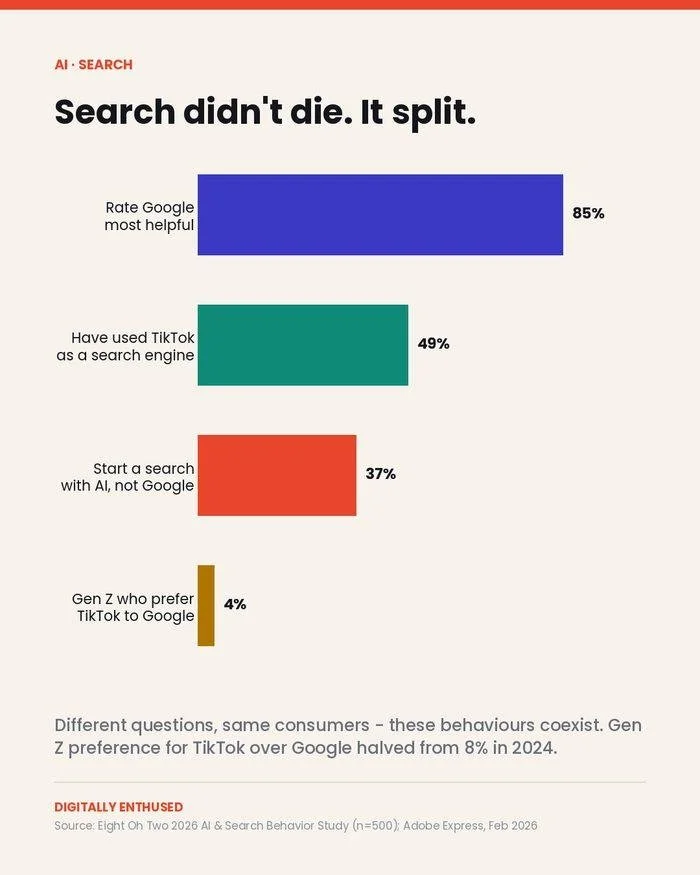
Four numbers that belong on the same slide:
37% of consumers now start a search with AI rather than a search engine. 49% of Americans have used TikTok as a search engine, up from 41% in 2024. Google is still rated most helpful by 85% of people. And the share of Gen Z who actually prefer TikTok to Google fell from 8% to 4% — it halved.
Everyone quotes whichever one supports the deck they're already writing.
What's actually happening is that people route by question type. "Best waterproof mascara for oily lids" goes to TikTok, because they want a face and a verdict. "Compare these three CRMs for a 40-person team" goes to AI, because they want it synthesised. "Hours for the dentist on Mill Street" goes to Google, because they want a fact in two seconds.
The case FOR restructuring around AI search now:
47% say AI influences which brands they trust. 59% expect it to become their main way of finding things
First-mover advantage in citation is real, and the bar right now is embarrassingly low
It forces content discipline: clear claims, sourced numbers, actual answers
The case AGAINST overcorrecting:
85% of people double-check AI answers somewhere else. AI is a starting point, not a destination
Using TikTok to search isn't preferring it — and the preference number is going down, not up
Optimising for machine citation while your human readers bounce is a spectacular own goal
Where I land: stop asking "which channel wins" and start auditing which questions your buyers ask — then map each to where it actually gets asked.
For most brands that means the same underlying truth gets three bodies: a 40-second face-to-camera answer, a clearly structured page a model can quote, and a page that ranks.
The work isn't picking a platform. It's being findable in more than one grammar.
Where are you seeing the biggest shift in how people arrive at you? I'd especially like to hear from anyone who's tracked organic search falling and AI referrals rising — the anecdotes are well ahead of the data.
Notes on the data
Two caveats. The Adobe blog and the SEJ piece are the same underlying survey, not two independent studies. And Adobe's sample was only about 15% Gen Z, so treat the Gen Z cuts as directional.
The halving still holds up though, and almost nobody is talking about it.