
The highest-ROI marketing job of 2026 is schema markup. I'm sorry.
The highest-ROI marketing job available to you right now is structured data.
I know. I've written more exciting sentences.
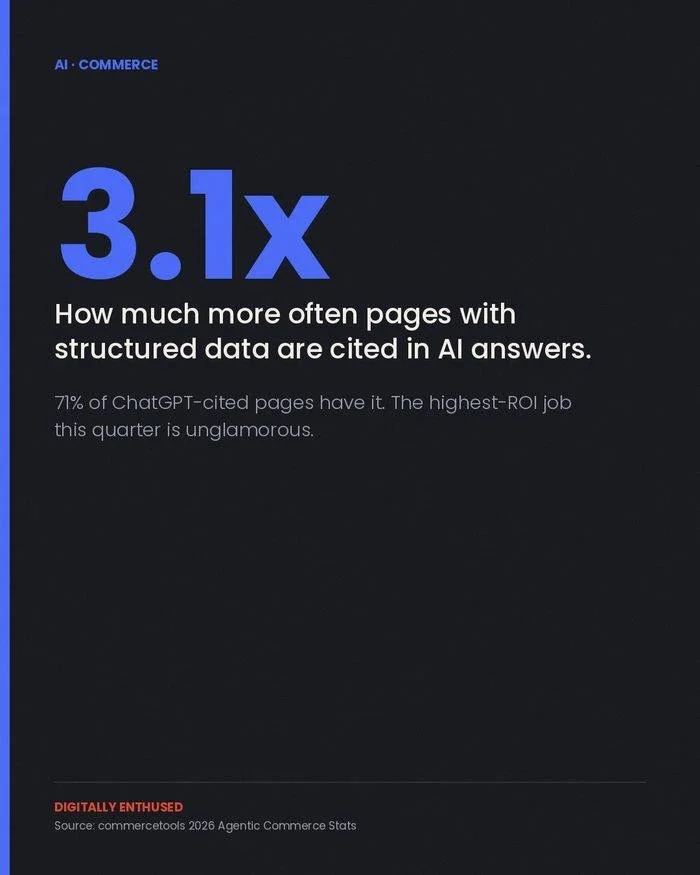
But here are the numbers. Pages with structured data are cited 3.1x more often in Google's AI Overviews. 71% of ChatGPT-cited pages include structured data. 65% of Google AI-cited pages do.
Meanwhile 45% of organisations say they "sometimes" have data quality problems and 36% say "often." Which is a corporate way of saying most product catalogues are a mess.
So the situation is: there's a new discovery layer, we know roughly what it rewards, and most companies are failing the easiest part of the test.
The case FOR making this a priority this quarter:
It's cheap, one-time, and technical. No creative debate, no brand committee, no waiting on legal
It compounds across AI answers, traditional search, shopping feeds, and every agent that shows up next
Being accurately described is the floor. You cannot win a comparison you're not included in
The case AGAINST treating it as a strategy:
Structured data is table stakes, not advantage. When everyone does it, the differentiator moves back to what you actually sell
Correlation warning: cited pages have schema, but they also tend to be better pages from more established sites. Schema is not a magic ranking spell
AI-driven sessions are still under 0.2% of ecommerce traffic. Don't reallocate half your budget to a channel that's currently a rounding error
Where I land: do the boring work because it's cheap, not because it's the future.
Practically, this quarter: clean product titles and attributes, real specs instead of marketing adjectives, schema on products, FAQs and reviews, a clear returns policy in plain text, and pricing that a machine can parse without a screenshot.
None of that will win an award. All of it makes you legible to every system that decides what a buyer sees — including the humans, who are also just skimming for facts.
The unglamorous work is usually the available work. That's why it stays available.
Who here has actually shipped a schema overhaul in the last year — did you see anything measurable, or did it just quietly stop things from getting worse?
Notes on the data
The caveat worth repeating, because it's the honest one: AI-driven sessions are still under 0.2% of ecommerce traffic.
So do the schema work because it's cheap and it also helps traditional search — not because agents are about to become your main channel. Anyone reallocating half a budget to this is front-running the market by years.