
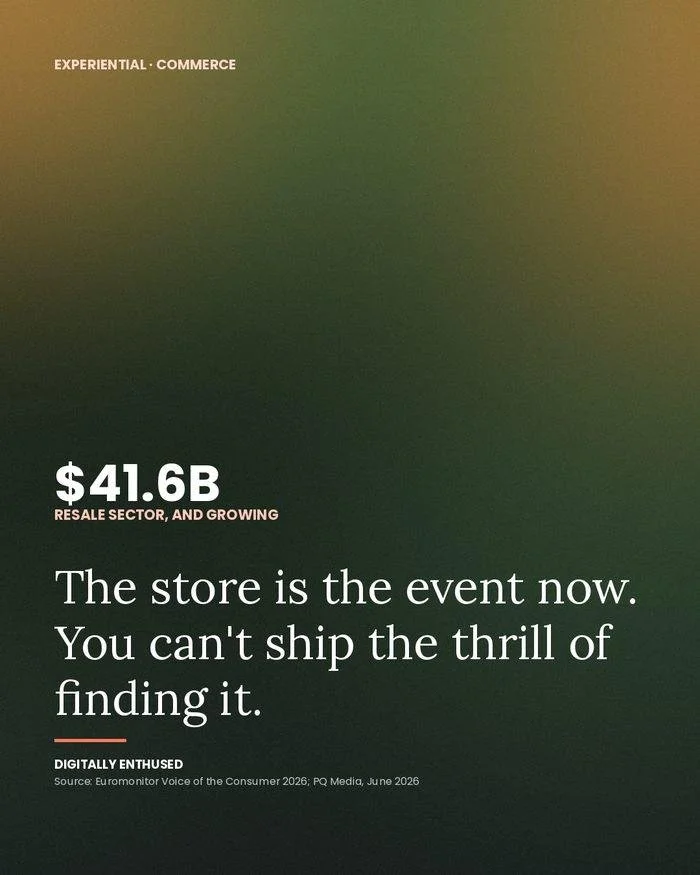
Resale is a $41.6B business and it's turning stores into venues.
Euromonitor puts the resale sector at $41.6B. Over 55% of consumers now prioritise experience-based spending, and 22% expect to spend more on unique experiences this year.
Those facts are converging somewhere most people aren't watching: physical retail.
Because if the thing you're selling is secondhand, scarce or one-of-one, then browsing is the experience. You can't ship the thrill of finding it. The store stops being a distribution point and becomes a venue.
Watch what's working on high streets right now. Drop days. Trade-in counters with a queue. Repair bars. Vintage curation with a named buyer whose taste people follow. All of it is retail behaving like an event — scarcity, timing, community, and a reason to be there on Saturday rather than at 11pm on your phone.
The case FOR building retail as experience:
Foot traffic you don't have to buy. A drop does what a media plan can't
It addresses circularity and loyalty in the same move — trade-in brings people back by design
Global experiential spend is running near $153B and growing double digits. The money is going somewhere, and increasingly it's going into space
The case AGAINST:
Property is expensive and inflexible in a way a campaign isn't. You're signing a lease against a trend
Resale margins are thin and the operational load is heavy: authentication, grading, cleaning, storage, unpredictable supply
Cannibalisation is real. A thriving trade-in programme sells fewer new units, and someone's forecast is about to have a bad quarter
"Experience" is often just a nicer word for expensive. Plenty of concept stores are beautiful, well-photographed and losing money
And be careful with that $41.6B — the source doesn't state a geography or category, so don't build a business case on it alone
Where I land: resale isn't a sustainability initiative, it's a traffic strategy that happens to be good for the planet.
Brands treating it as CSR run a sad rail at the back of the store. Brands treating it as commerce put it at the front, staff it with someone who knows the archive, and turn Saturday into a reason to leave the house.
Retail's advantage was never convenience — it lost that a decade ago. Its advantage is that it's somewhere to be.
Bought secondhand from a brand directly this year? Did it make you more or less likely to buy new from them?
Notes on the data
Honest flag on the $41.6B: Euromonitor prints it without a stated geography, year or category, and it sits well below most global secondhand estimates. So it's probably luxury resale, not all resale. Use it as a signal, not a business case.